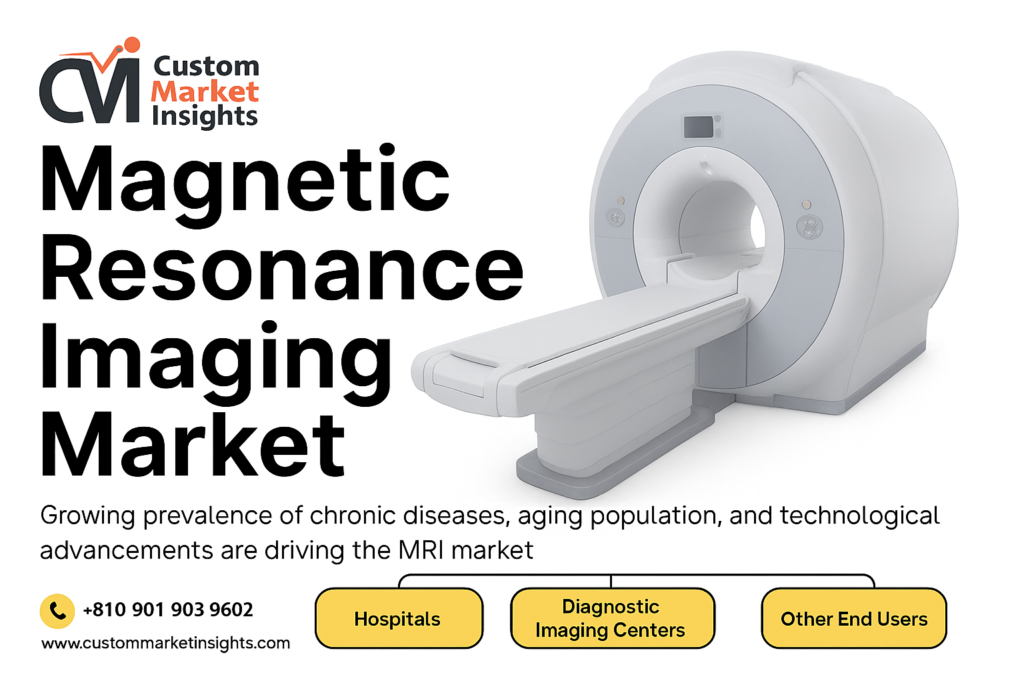
The global Magnetic Resonance Imaging (MRI) market is experiencing steady growth, driven by technological advancements, increasing prevalence of chronic diseases, and rising demand for non-invasive diagnostic imaging solutions. According to recent market analysis, the MRI market was valued at USD 7.2 billion in 2026 and is projected to reach USD 15.6 billion by 2034, expanding at a compound annual growth rate (CAGR) of 6.7% during the forecast period.
Magnetic Resonance Imaging has become a cornerstone in modern medical diagnostics, offering high-resolution imaging without ionizing radiation. Its expanding applications across neurology, cardiology, oncology, and musculoskeletal disorders continue to strengthen its position as a critical diagnostic modality worldwide.
Market Overview
MRI technology utilizes strong magnetic fields and radio waves to generate detailed images of internal organs and tissues. Its ability to provide superior soft tissue contrast compared to other imaging techniques such as CT scans or X-rays has made it indispensable in clinical settings.
The growth of the MRI market is fueled by the increasing burden of diseases such as brain tumors, spinal disorders, cardiovascular diseases, and breast cancer. Additionally, the aging global population is contributing significantly to the demand for diagnostic imaging services, further supporting market expansion.
Key Market Drivers
1. Rising Prevalence of Chronic Diseases
The increasing incidence of neurological disorders, cancer, and cardiovascular diseases is a major factor driving the demand for MRI systems. MRI plays a vital role in early diagnosis, treatment planning, and disease monitoring.
2. Technological Advancements
Continuous innovations in MRI technology, such as high-field MRI systems, artificial intelligence (AI)-integrated imaging, and faster scanning techniques, are enhancing diagnostic accuracy and patient experience. Advanced features like functional MRI (fMRI) and diffusion tensor imaging (DTI) are expanding the clinical applications of MRI.
3. Growing Demand for Non-Invasive Diagnostics
MRI is a non-invasive and radiation-free imaging technique, making it a preferred choice for both patients and healthcare providers. This is particularly important in pediatric and repeat imaging cases.
4. Expansion of Healthcare Infrastructure
Emerging economies are investing heavily in healthcare infrastructure, including diagnostic imaging facilities. This expansion is creating significant growth opportunities for MRI system manufacturers.
Market Segmentation
By Product
Open MRI Systems
Open MRI systems are gaining popularity due to their patient-friendly design, especially for claustrophobic and pediatric patients. These systems provide a more comfortable scanning experience but typically operate at lower magnetic field strengths.
Closed MRI Systems
Closed MRI systems dominate the market due to their superior image quality and higher field strengths. They are widely used in hospitals and diagnostic centers for detailed imaging.
By Field Strength
Low Field Strength MRI
Low-field MRI systems are cost-effective and suitable for basic diagnostic applications. They are often used in smaller healthcare facilities.
Mid Field Strength MRI
Mid-field systems offer a balance between cost and performance, making them suitable for a wide range of clinical applications.
High Field Strength MRI
High-field MRI systems (1.5T and 3T) are the most widely adopted due to their high-resolution imaging capabilities. These systems are essential for advanced diagnostics, including neurological and cardiac imaging.
By Application
Brain and Neurological Imaging
MRI is extensively used for diagnosing brain tumors, stroke, multiple sclerosis, and other neurological conditions. This segment holds a significant share of the market.
Spine and Musculoskeletal Imaging
MRI is the preferred modality for evaluating spinal injuries, joint disorders, and soft tissue abnormalities.
Vascular Imaging
MRI angiography is widely used to assess blood vessels and detect abnormalities such as aneurysms and blockages.
Abdominal Imaging
MRI is increasingly used for liver, kidney, and gastrointestinal imaging, offering high accuracy without radiation exposure.
Cardiac Imaging
Cardiac MRI provides detailed information about heart structure and function, aiding in the diagnosis of complex cardiovascular conditions.
Breast Imaging
Breast MRI is used as a complementary tool to mammography for early detection of breast cancer, especially in high-risk patients.
Regional Analysis
North America
North America holds the largest share of the MRI market, driven by advanced healthcare infrastructure, high healthcare expenditure, and early adoption of innovative technologies. The presence of major players further strengthens the region’s dominance.
Europe
Europe represents a significant market, supported by government initiatives, increasing healthcare investments, and a growing aging population.
Asia-Pacific
The Asia-Pacific region is expected to witness the fastest growth during the forecast period. Rapid urbanization, improving healthcare infrastructure, and increasing awareness about early disease diagnosis are key factors driving growth.
Latin America and Middle East & Africa
These regions are gradually expanding due to improving healthcare access and increasing investments in diagnostic imaging technologies.
Competitive Landscape
The global MRI market is highly competitive, with several established players focusing on innovation, strategic partnerships, and geographic expansion to strengthen their market presence.
Key companies operating in the market include:
- Siemens Healthineers
- GE Healthcare
- Philips Healthcare
- Canon Medical Systems Corporation
- Hitachi Medical Systems
- Hologic Inc.
- Esaote SpA
- Fonar Corporation
- Neusoft Medical Systems Co. Ltd.
- United Imaging Healthcare Co. Ltd.
Other notable players include Time Medical Systems, Aurora Imaging Technology Inc., Bruker Corporation, Aspect Imaging Ltd., Mediso Medical Imaging Systems, MR Solutions Ltd., IMRIS (Deerfield Imaging), MR Instruments Inc., Paramed Medical Systems, and Shenzhen Basda Medical Apparatus Co. Ltd.
These companies are investing heavily in research and development to introduce advanced MRI systems with improved efficiency, reduced scan times, and enhanced patient comfort.
Emerging Trends
Integration of Artificial Intelligence
AI is transforming MRI by enabling faster image acquisition, automated analysis, and improved diagnostic accuracy. AI-powered MRI systems can significantly reduce scan times and enhance workflow efficiency.
Portable and Compact MRI Systems
The development of portable MRI systems is gaining traction, particularly in remote and underserved areas. These systems improve accessibility to advanced diagnostic imaging.
Focus on Patient Comfort
Manufacturers are increasingly focusing on patient-centric designs, including wider bores, quieter machines, and shorter scan times to improve patient experience.
Hybrid Imaging Systems
The integration of MRI with other imaging modalities is opening new possibilities in diagnostic imaging, particularly in oncology and neurology.
Challenges
Despite its growth, the MRI market faces certain challenges:
- High Cost of Equipment: MRI systems are expensive to install and maintain, limiting their adoption in low-income regions.
- Limited Accessibility: Rural and underdeveloped areas still lack access to advanced imaging technologies.
- Long Scan Times: Although improving, MRI scans can still be time-consuming compared to other imaging modalities.
Future Outlook
The future of the MRI market looks promising, with continued advancements in imaging technology and increasing adoption across various medical specialties. The integration of AI, development of portable systems, and expansion in emerging markets are expected to drive significant growth.
As healthcare systems worldwide prioritize early diagnosis and precision medicine, MRI will continue to play a critical role in improving patient outcomes. The market is set to witness sustained expansion, supported by innovation and increasing global healthcare demand.
Conclusion
The global Magnetic Resonance Imaging market is on a strong growth trajectory, driven by technological advancements, rising disease prevalence, and increasing demand for accurate and non-invasive diagnostic solutions. With a projected market size of USD 15.6 billion by 2034, the industry presents substantial opportunities for stakeholders.
Companies that focus on innovation, affordability, and accessibility will be well-positioned to capitalize on the growing demand and shape the future of diagnostic imaging.