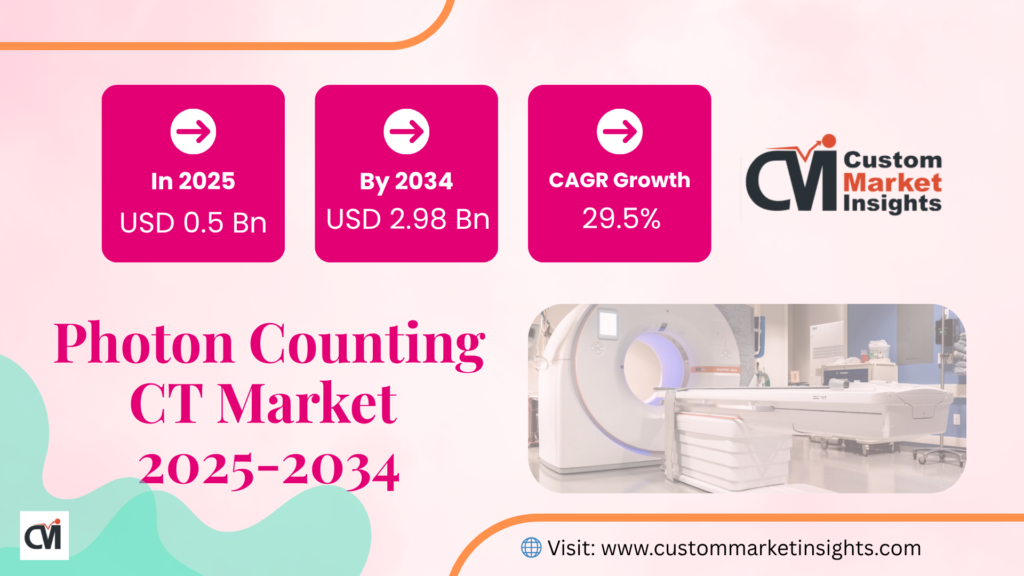
According to the latest analysis conducted by the CMI Team, the global Photon Counting CT Market is poised for exponential growth over the coming decade. The market is projected to reach USD 0.5 Billion in 2026 and is expected to surge to approximately USD 2.98 Billion by 2034, registering an impressive CAGR of 29.5% during the forecast period.
Photon counting computed tomography (CT) is an advanced imaging technology that represents a significant leap forward from conventional CT systems. By directly measuring individual X-ray photons and their energy levels, photon counting CT delivers higher resolution images, improved tissue characterization, and lower radiation exposure. As healthcare systems increasingly shift toward precision diagnostics, this next-generation imaging modality is gaining rapid traction worldwide.
Market Overview
Photon counting CT technology is revolutionizing medical imaging by overcoming the limitations of traditional energy-integrating detectors. Unlike conventional CT systems, which measure the total energy deposited, photon counting CT systems count individual photons and categorize them based on their energy levels. This enables superior image quality, enhanced contrast resolution, and reduced image noise.
The growing demand for accurate, early-stage diagnosis of complex diseases such as cancer, cardiovascular conditions, and neurological disorders is fueling the adoption of photon counting CT. Additionally, ongoing advancements in detector materials and system integration are accelerating commercialization and expanding clinical applications.
Key Market Drivers
1. Rising Demand for High-Precision Imaging
The increasing need for early and accurate diagnosis is one of the primary drivers of the photon counting CT market. This technology provides detailed anatomical and functional insights, making it particularly valuable in oncology, cardiology, and neurology.
2. Technological Advancements in CT Imaging
Continuous innovation in detector technologies, particularly photon counting detectors (PCDs), has significantly improved imaging performance. These advancements allow clinicians to achieve better diagnostic outcomes with lower radiation doses.
3. Increasing Prevalence of Chronic Diseases
The global burden of chronic diseases such as cancer, cardiovascular disorders, and neurological conditions is rising rapidly. This has led to increased demand for advanced imaging solutions capable of detecting diseases at early stages.
4. Growing Focus on Radiation Dose Reduction
Photon counting CT systems offer substantial reductions in radiation exposure compared to conventional CT scanners. This is especially important in pediatric imaging and for patients requiring repeated scans.
Market Restraints
1. High Initial Investment Costs
Photon counting CT systems are expensive due to their advanced technology and complex manufacturing processes. This can limit adoption, particularly in developing regions with budget constraints.
2. Limited Availability and Commercialization
Although the technology shows great promise, its availability is still limited, and widespread adoption is in the early stages.
3. Technical Challenges
Developing reliable and scalable photon counting detectors requires overcoming challenges related to detector efficiency, energy resolution, and data processing capabilities.
Market Segmentation Analysis
By Application
- Diagnostic Imaging:
Dominates the market due to widespread use in detecting and monitoring diseases. Enhanced image clarity and tissue differentiation make photon counting CT highly suitable for clinical diagnostics. - Interventional Imaging:
Growing application in guiding minimally invasive procedures, offering real-time, high-resolution imaging. - Research & Preclinical Imaging:
Widely used in academic and pharmaceutical research for studying disease mechanisms and evaluating new therapies.
Diagnostic imaging remains the largest segment, driven by increasing clinical adoption.
By Detector Technology
- Photon Counting Detectors (PCDs):
The core technology behind photon counting CT systems. These detectors provide superior spatial resolution, energy discrimination, and noise reduction. - Energy Integrating Detectors (EIDs):
Traditional detectors used for comparison and hybrid systems. While widely used, they lack the advanced capabilities of PCDs.
The PCD segment dominates and is expected to grow rapidly as technology matures.
By Modality
- Clinical Photon Counting CT:
Used in hospitals and diagnostic centers for patient imaging. This segment is witnessing rapid growth due to increasing adoption in clinical settings. - Preclinical / Research Photon Counting CT:
Utilized in research institutions for experimental studies and drug development.
Clinical photon counting CT systems hold the largest market share due to their direct impact on patient care.
By End User
- Hospitals & Diagnostic Imaging Centers:
The largest segment, driven by high patient volumes and demand for advanced imaging technologies. - Academic & Research Institutions:
Significant users of photon counting CT for research and innovation. - Pharmaceutical & Biotechnology Companies:
Increasing use in drug development and clinical trials. - Specialty Clinics & Outpatient Imaging Centers:
Emerging segment with growing adoption of advanced imaging solutions.
Hospitals and diagnostic centers dominate due to their central role in healthcare delivery.
Regional Analysis
North America
North America holds a leading position in the photon counting CT market, supported by advanced healthcare infrastructure, high adoption of cutting-edge technologies, and strong presence of major industry players.
Europe
Europe is witnessing steady growth, driven by increasing investments in healthcare and rising demand for advanced diagnostic tools.
Asia-Pacific
The Asia-Pacific region is expected to register the fastest growth during the forecast period. Rapid urbanization, expanding healthcare infrastructure, and increasing awareness about early diagnosis are key growth drivers in countries such as India, China, and Japan.
Latin America and Middle East & Africa
These regions are gradually adopting advanced imaging technologies, supported by improving healthcare systems and rising investments.
Competitive Landscape
The global photon counting CT market is highly competitive, with several key players focusing on innovation, product development, and strategic collaborations.
Some of the leading companies include:
- Siemens Healthineers
- GE Healthcare
- Philips Healthcare
- Canon Medical Systems Corporation
- United Imaging Healthcare
- NeuroLogica Corporation
- Hitachi Healthcare
- Fujifilm Holdings Corporation
- Carestream Health
- Neusoft Medical Systems
- Konica Minolta Inc.
- Planmed Oy
- Analogic Corporation
- Elekta AB
- Bruker Corporation
These companies are investing heavily in research and development to bring next-generation photon counting CT systems to market. Partnerships with healthcare providers and research institutions are also playing a crucial role in accelerating adoption.
Emerging Trends
Integration with Artificial Intelligence (AI)
AI is increasingly being integrated with photon counting CT systems to enhance image reconstruction, automate analysis, and improve diagnostic accuracy.
Expansion of Clinical Applications
Photon counting CT is expanding beyond traditional imaging to include applications in cardiology, oncology, and musculoskeletal imaging.
Focus on Personalized Medicine
The ability to provide detailed tissue characterization supports personalized treatment planning and precision medicine.
Increasing Research Activities
Academic and research institutions are активно exploring new applications of photon counting CT, driving innovation and market growth.
Future Outlook
The photon counting CT market is expected to witness transformative growth over the next decade. With a CAGR of 29.5%, the market represents one of the fastest-growing segments in the medical imaging industry.
As technology advances and costs decrease, photon counting CT systems are likely to become more accessible, enabling widespread adoption across healthcare settings. Emerging markets will play a crucial role in driving future growth, supported by increasing healthcare investments and demand for advanced diagnostic tools.
Conclusion
In conclusion, the global Photon Counting CT Market is on a rapid growth trajectory, driven by technological innovation, rising demand for high-precision imaging, and increasing prevalence of chronic diseases. The market’s projected expansion from USD 0.5 Billion in 2026 to USD 2.98 Billion by 2034 highlights its immense potential.