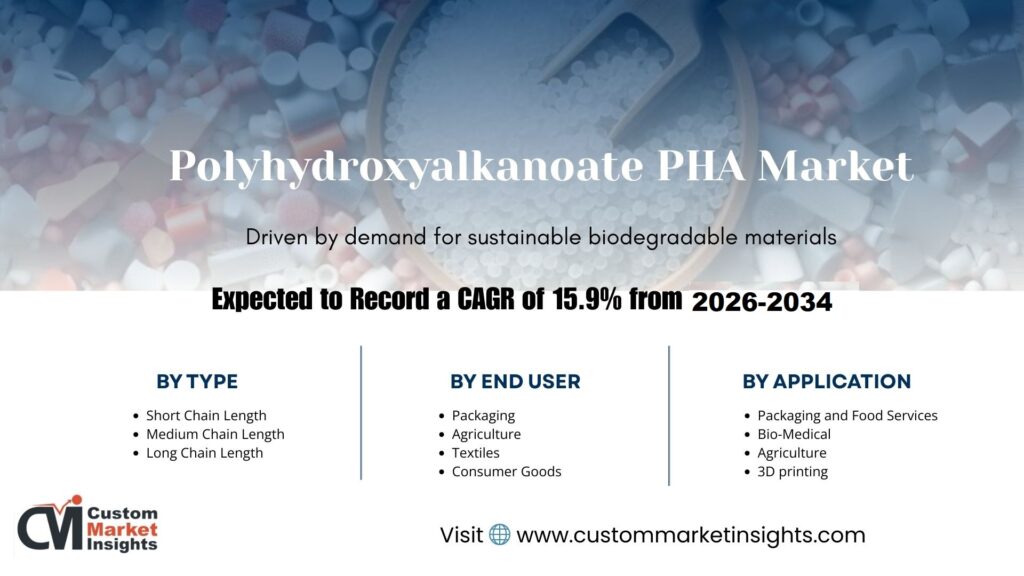
As per the analysis conducted by the CMI Team, the global Polyhydroxyalkanoate (PHA) market is poised for robust growth, driven by increasing demand for sustainable and biodegradable alternatives to conventional plastics. The market is expected to record a CAGR of 15.9% from 2026 to 2034. In 2026, the market size is projected to reach approximately USD 121.2 million, and by 2034, it is anticipated to grow to around USD 265.5 million.
Polyhydroxyalkanoates (PHAs) are a family of biodegradable polymers produced by microbial fermentation of renewable resources such as vegetable oils, sugars, and organic waste. With rising environmental concerns and stringent regulations against single-use plastics, PHAs are gaining significant traction across multiple industries, including packaging, agriculture, and biomedical applications.
Market Overview
The PHA market is emerging as a critical segment within the broader bioplastics industry. These materials offer unique advantages such as biodegradability, biocompatibility, and versatility, making them suitable for a wide range of applications. Unlike traditional plastics, PHAs can degrade naturally in soil and marine environments, addressing the growing issue of plastic pollution.
The increasing shift toward a circular economy and sustainable materials is encouraging manufacturers to invest in bio-based polymers. Governments worldwide are also supporting the adoption of biodegradable plastics through favorable policies, subsidies, and bans on conventional plastics.
Market Drivers
Growing Environmental Awareness
Rising concerns about plastic waste and its impact on ecosystems are driving the demand for biodegradable materials. PHAs offer a sustainable solution as they decompose naturally without leaving harmful residues.
Stringent Regulations on Plastics
Governments across regions are implementing strict regulations and bans on single-use plastics. This is accelerating the adoption of biodegradable alternatives such as PHAs in packaging and consumer goods.
Increasing Demand for Sustainable Packaging
The packaging industry is one of the largest consumers of plastics. The shift toward eco-friendly packaging solutions is a major factor boosting the PHA market.
Advancements in Biotechnology
Technological advancements in microbial fermentation and genetic engineering are improving the efficiency and cost-effectiveness of PHA production, making it more commercially viable.
Market Restraints
High Production Costs
PHA production is still relatively expensive compared to conventional plastics, which limits its widespread adoption.
Limited Production Capacity
The global production capacity for PHAs is currently limited, which can restrict supply and increase prices.
Performance Limitations
While PHAs offer environmental benefits, they may not always match the mechanical and thermal properties of traditional plastics in certain applications.
Market Opportunities
Expansion in Emerging Economies
Developing regions are increasingly adopting sustainable materials due to growing environmental awareness and regulatory support, presenting significant growth opportunities.
Innovations in Feedstock Utilization
The use of waste materials and non-food biomass as feedstock for PHA production can reduce costs and improve sustainability.
Increasing Applications in Biomedical Sector
PHAs are biocompatible and biodegradable, making them ideal for medical applications such as sutures, implants, and drug delivery systems.
Market Segmentation
By Type
Short Chain Length (SCL-PHA)
This segment dominates the market due to its widespread use in packaging and consumer goods. SCL-PHAs offer good rigidity and are suitable for producing films and containers.
Medium Chain Length (MCL-PHA)
MCL-PHAs are more flexible and elastomeric, making them suitable for applications requiring higher flexibility, such as coatings and adhesives.
Long Chain Length (LCL-PHA)
This segment is still in the early stages of development but holds potential for specialized applications requiring enhanced material properties.
By Form
Co-polymerized PHA
Co-polymerized PHAs offer improved mechanical properties and flexibility compared to homopolymers. This segment is gaining traction due to its versatility.
Linear PHA
Linear PHAs are simpler in structure and are used in applications where basic biodegradability is required.
By Application
Packaging and Food Services
This is the largest application segment, driven by the demand for sustainable packaging solutions. PHAs are used in food containers, films, and disposable items.
Bio-Medical
PHAs are used in medical applications such as sutures, implants, and tissue engineering due to their biocompatibility.
Agriculture
In agriculture, PHAs are used for mulch films, controlled-release fertilizers, and other applications that benefit from biodegradability.
Wastewater Treatment
PHAs are used in wastewater treatment processes as biodegradable materials that support microbial activity.
Cosmetics
The cosmetics industry uses PHAs in packaging and formulations as eco-friendly alternatives.
3D Printing
The growing adoption of biodegradable materials in additive manufacturing is driving the use of PHAs in 3D printing applications.
Chemical Additives
PHAs are used as additives to enhance the biodegradability of conventional plastics.
By End User
Packaging Industry
The packaging sector holds the largest market share, driven by increasing demand for eco-friendly materials.
Agriculture
The use of biodegradable materials in agriculture is growing, particularly in sustainable farming practices.
Textiles
PHAs are being explored for use in sustainable textile production.
Consumer Goods
Eco-friendly consumer products are driving the adoption of PHAs in this segment.
Others
Includes automotive, electronics, and other industrial applications.
Regional Analysis
North America
North America is a significant market for PHAs, driven by strong environmental regulations and high consumer awareness. The United States is a key contributor to regional growth.
Europe
Europe leads in sustainability initiatives and has implemented strict regulations on plastic usage. Countries such as Germany, France, and the UK are at the forefront of adopting biodegradable materials.
Asia-Pacific
The Asia-Pacific region is expected to witness the fastest growth during the forecast period. Rapid industrialization, increasing environmental awareness, and government initiatives in countries like China, Japan, and India are driving market expansion.
Rest of the World
Regions such as Latin America and the Middle East are gradually adopting biodegradable materials, offering potential growth opportunities in the future.
Competitive Landscape
The global PHA market is highly competitive, with numerous players focusing on innovation, capacity expansion, and strategic partnerships to strengthen their market position.
Leading Players
- Danimer Scientific
- TianAn Biologic Materials Co. Ltd.
- Kaneka Corporation
- P&G Chemicals
- Tepha Inc.
- Newlight Technologies LLC
- Bio-on S.p.A.
- Yield10 Bioscience Inc.
- PHB Industrial S.A
- Others
These companies are actively investing in R&D to improve production efficiency and expand their product portfolios. Strategic collaborations and partnerships are common strategies to enhance market presence.
Key Trends
Shift Toward Circular Economy
Companies are increasingly adopting circular economy principles, focusing on recycling and sustainable material use.
Integration with Waste Management Systems
PHA production using organic waste as feedstock is gaining attention as a sustainable solution.
Rising Demand for Marine Biodegradable Plastics
PHAs are gaining popularity due to their ability to degrade in marine environments, addressing ocean pollution concerns.
Technological Innovations
Advancements in biotechnology and material science are improving the performance and cost-effectiveness of PHAs.
Future Outlook
The future of the PHA market looks promising, with strong growth potential driven by sustainability trends and regulatory support. As production technologies improve and costs decrease, PHAs are expected to become more competitive with conventional plastics.
The increasing adoption of biodegradable materials across industries will further drive market expansion, positioning PHAs as a key component of the global bioplastics industry.
The global Polyhydroxyalkanoate (PHA) market is set for significant growth, supported by rising environmental awareness, regulatory pressures, and technological advancements. While challenges such as high costs and limited production capacity remain, the market offers substantial opportunities for innovation and expansion.
As industries continue to shift toward sustainable materials, PHAs are expected to play a crucial role in reducing plastic pollution and promoting a greener future.