
Market Size
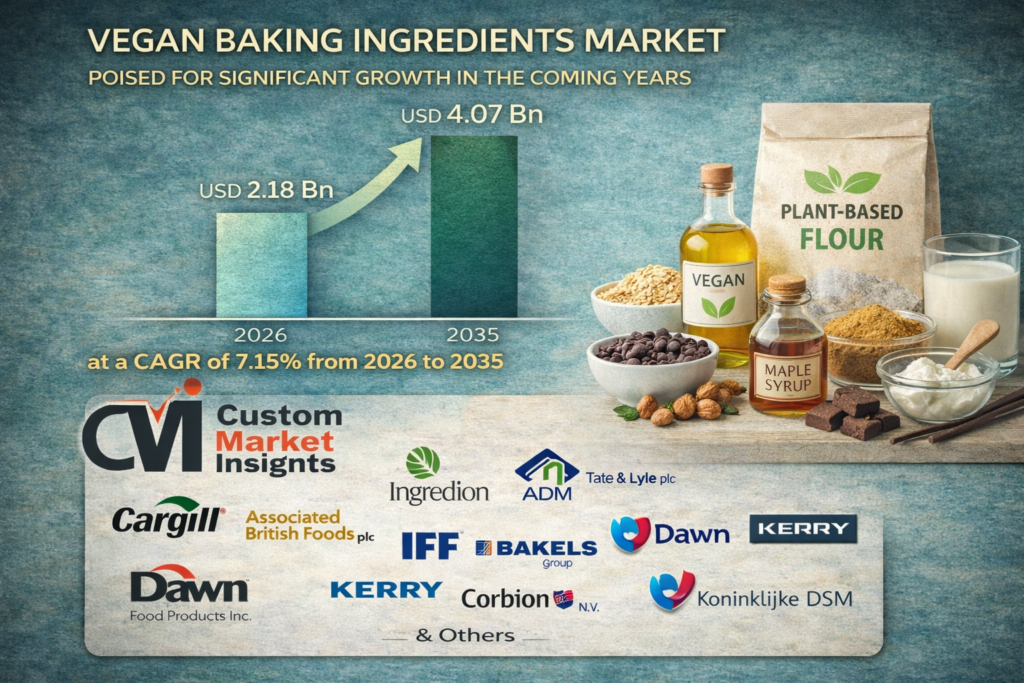
The Global Vegan Baking Ingredients Market is witnessing steady growth, driven by the rising adoption of plant-based diets and increasing consumer awareness regarding sustainability and health. According to the analysis conducted by the CMI team, the market is projected to register a CAGR of 7.15% from 2026 to 2035.
In 2026, the market size was valued at USD 2.18 billion, reflecting growing demand for vegan alternatives in baking applications. By 2035, the market is anticipated to reach approximately USD 4.07 billion, showcasing consistent expansion across both developed and emerging economies.
This growth trajectory highlights the increasing shift toward clean-label, allergen-free, and environmentally sustainable baking ingredients across the global food industry.
Market Overview
Vegan baking ingredients refer to plant-based substitutes used in baking that eliminate animal-derived components such as eggs, butter, milk, and honey. These ingredients include plant-based flours, oils, natural sweeteners, and flavoring agents designed to replicate the texture, taste, and functionality of traditional baking inputs.
The market is gaining momentum due to the rising popularity of veganism, flexitarian diets, and lactose-free or allergen-free food preferences. Consumers are increasingly seeking healthier alternatives without compromising on taste and quality, prompting manufacturers to innovate and expand their product portfolios.
Additionally, the growing influence of social media, food blogs, and plant-based culinary trends has accelerated the adoption of vegan baking products among home bakers and commercial food producers alike.
Key Market Growth Drivers
1. Rising Popularity of Plant-Based Diets
The increasing adoption of vegan and vegetarian lifestyles is one of the primary drivers of the market. Consumers are shifting toward plant-based foods for ethical, environmental, and health reasons, boosting demand for vegan baking ingredients.
2. Growing Health Consciousness
Consumers are becoming more aware of the health benefits associated with plant-based diets, including reduced cholesterol levels and improved digestion. Vegan baking ingredients often contain fewer allergens and artificial additives, making them an attractive option.
3. Expansion of Clean-Label Products
The demand for clean-label and natural ingredients is rising globally. Consumers prefer products with transparent labeling, minimal processing, and recognizable ingredients, which aligns well with vegan baking trends.
4. Innovation in Food Technology
Advancements in food science have led to the development of high-performance vegan substitutes that closely mimic the functionality of traditional ingredients. This has significantly improved the quality of vegan baked goods.
5. Growth of the Bakery Industry
The global bakery sector continues to expand, with increasing demand for cakes, breads, cookies, and pastries. The inclusion of vegan options in bakery menus is further driving market growth.
Analysis of Key Players & Key Player Strategies
The vegan baking ingredients market is moderately fragmented, with a mix of global food giants and specialized ingredient manufacturers competing for market share.
Leading Players
- Cargill
- Associated British Foods plc
- Ingredion Incorporated
- Archer Daniels Midland Company
- Tate & Lyle plc
- IFF Inc.
- Bakels Group
- Dawn Food Products Inc.
- Kerry Group
- Corbion N.V.
- Koninklijke DSM N.V.
Key Player Strategies
1. Product Innovation
Companies are focusing on developing advanced vegan ingredients that offer better taste, texture, and shelf life.
2. Strategic Acquisitions
Mergers and acquisitions are helping players expand their product portfolios and strengthen their market presence.
3. Expansion into Emerging Markets
Key players are targeting high-growth regions such as Asia Pacific to tap into increasing demand.
4. Clean-Label Positioning
Brands are emphasizing transparency and natural ingredients to attract health-conscious consumers.
5. Partnerships with Bakeries & Food Chains
Collaborations with commercial bakeries and foodservice providers are enabling companies to expand their customer base.
Market Challenges & Opportunities
Challenges
1. High Cost of Vegan Ingredients
Vegan substitutes often cost more than traditional ingredients, which can limit adoption, especially in price-sensitive markets.
2. Taste and Texture Limitations
Despite advancements, replicating the exact taste and texture of traditional baked goods remains a challenge.
3. Limited Consumer Awareness in Developing Regions
In some regions, awareness of vegan products is still low, which can hinder market growth.
4. Supply Chain Constraints
Sourcing high-quality plant-based raw materials can be challenging due to seasonal and regional variations.
Opportunities
1. Growing Demand for Allergen-Free Products
Vegan ingredients are naturally free from common allergens like dairy and eggs, creating opportunities in niche markets.
2. Expansion of Vegan Product Lines
Food manufacturers are increasingly launching vegan versions of popular baked goods.
3. Rising Popularity of Home Baking
The surge in home baking trends is boosting demand for vegan baking ingredients among consumers.
4. Sustainability Trends
Plant-based ingredients have a lower environmental footprint, aligning with global sustainability goals.
Investment Landscape and ROI Outlook
The vegan baking ingredients market presents attractive investment opportunities due to its steady growth and evolving consumer preferences. Investors are increasingly focusing on companies that offer innovative, sustainable, and scalable solutions.
The projected CAGR of 7.15% indicates a stable and promising return on investment over the long term. Venture capital firms and private equity investors are actively funding startups specializing in plant-based ingredients and alternative proteins.
Additionally, the shift toward premium and specialty vegan products is creating higher-margin opportunities, enhancing profitability for market participants.
Market Segmentations (with Region)
By Product
- Flour
- Oils
- Sweeteners
- Flavoring Agents
The flour segment dominated the market with 39% share, driven by its essential role in baking. Meanwhile, flavoring agents are expected to witness the fastest growth with a CAGR of 7.34%.
By Application
- Cakes & Pastries
- Breads & Rolls
- Biscuits & Cookies
The breads & rolls segment held the largest share at 44.32%, owing to high consumption globally. The biscuits & cookies segment is projected to grow at the fastest rate of 5.34%.
By Region
North America
- U.S.
- Canada
- Mexico
A mature market with high consumer awareness and strong demand for plant-based products.
Europe
- Germany, France, U.K., Italy, Spain, Netherlands, Russia
Europe dominated the market in 2025 with 33.32% share, driven by strong vegan adoption and regulatory support.
Asia Pacific
- China, Japan, India, Australia, South Korea, Taiwan
Expected to witness the fastest CAGR of 10.23%, fueled by urbanization and changing dietary habits.
Middle East & Africa
- Saudi Arabia, UAE, Egypt, South Africa
Gradual growth supported by increasing awareness and expanding retail sectors.
Latin America
- Brazil, Argentina
Emerging market with growing demand for plant-based food products.
Why Buy This Report?
- Gain comprehensive insights into market size, trends, and forecasts (2026–2035)
- Understand key growth drivers and market dynamics
- Analyze competitive landscape and major player strategies
- Identify high-growth segments and regional opportunities
- Access reliable data for strategic decision-making
- Stay updated on emerging trends and innovations in vegan baking
FAQs
1. What are vegan baking ingredients?
Vegan baking ingredients are plant-based substitutes used in place of animal-derived components like eggs, dairy, and butter in baking.
2. What is driving the growth of this market?
The market is driven by rising plant-based diets, health awareness, clean-label trends, and sustainability concerns.
3. Which region dominates the market?
Europe currently dominates the market, while Asia Pacific is expected to grow at the fastest rate.
4. Which segment holds the largest market share?
The flour segment leads by product type, and breads & rolls dominate by application.
5. What are the future opportunities in this market?
Opportunities include innovation in vegan ingredients, expansion into emerging markets, and increasing demand for allergen-free products.